
Why Acworth's Red Clay Soil Matters for Concrete Projects
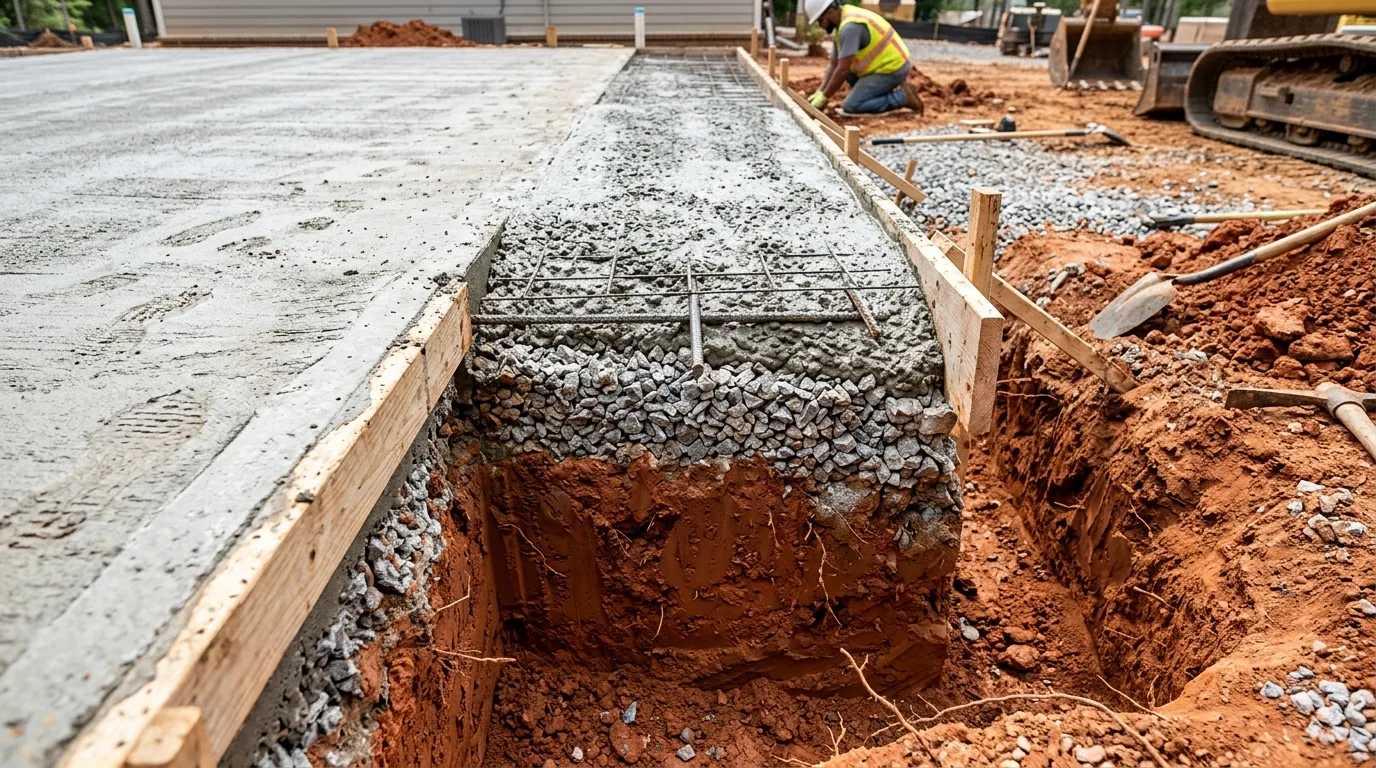
Here’s a question most Acworth homeowners don’t think to ask when getting concrete quotes: “What are you going to do about the clay?” The contractor’s answer — or lack of one — tells you more about the quality of the upcoming job than any other single question. Georgia’s Piedmont red clay is the primary reason concrete driveways and patios in Cobb County crack prematurely, and it’s entirely preventable with the right preparation.
In this post, we cover what Cobb County’s red clay actually does to concrete over time, how proper subgrade preparation breaks the damage cycle, and what you need to ask any contractor before a concrete project in Acworth.
Clay-Soil Concrete Done Right in Acworth
Proper gravel base, rebar reinforcement, drainage design — free estimates from Acworth Concrete Pros. Call (888) 376-0955.
Why Georgia’s Red Clay Matters for Acworth Concrete
Acworth sits firmly in Georgia’s Piedmont region, where the dominant soil type is red clay — specifically the Gwinnett clay loam, Cecil series, and Pacolett series soils that run through Cobb County from the eastern neighborhoods toward Bartow County. These are classified as expansive soils, meaning they change volume substantially as moisture content changes.
When Cobb County’s spring rains saturate the clay, it swells — sometimes exerting thousands of pounds of pressure per square foot against anything resting on or in it. When summer drought pulls moisture out of the clay, it shrinks — sometimes pulling away from slab edges entirely, creating voids that leave concrete sections unsupported. This cycle happens every year, in every season, beneath every property in Acworth — including the newer homes throughout Centennial Lakes and the established subdivisions in Camden Pointe.
The cumulative effect on improperly prepared concrete is predictable: edge cracking within 5–8 years, differential settling between adjacent panels within 10–12 years, and full surface failure requiring replacement within 15–20 years. None of this is inevitable with the right preparation.
Types of Preparation That Solve the Clay Problem
Compacted Gravel Base (Essential) The single most important clay-soil countermeasure is a properly compacted granular base between the red clay and the concrete slab. In Acworth, this means 4–6 inches of compacted #57 crushed stone — a well-graded angular aggregate that drains freely and doesn’t compress significantly under load. The gravel creates a stable, drainage-friendly layer that buffers the clay’s seasonal movement from reaching the concrete above it.
A contractor who proposes to pour directly on native clay soil — even “prepared” clay — in Cobb County should not be hired for this project. Full stop. The clay will move; the question is whether the concrete will accommodate it or crack under it.
Rebar Reinforcement (Recommended over Wire Mesh) Wire mesh reinforcement is common in residential concrete flatwork, but rebar is significantly more effective for concrete slabs on expansive clay soil. Rebar provides tensile strength that holds slab sections together when minor ground movement occurs beneath them. Wire mesh, by contrast, often settles to the bottom of the slab during the pour (negating its effectiveness) and provides less resistance to the bending forces that clay movement creates. For concrete driveways in Acworth and patios on red clay subgrade, rebar at 16–18 inch spacing is the appropriate specification.
Drainage Design (Critical at Perimeter) Poor drainage around concrete slabs is the accelerant that makes clay movement worse. Water that pools beside a driveway or patio edge creates the moisture swings that drive clay expansion — saturated soil one week, dried and cracked the next. Proper grading that directs water away from the slab at a minimum of 2% slope is part of every concrete installation, not an optional upgrade.
Practical Uses: Where Clay-Soil Knowledge Changes Outcomes
-
Concrete driveways in Acworth neighborhoods: A driveway poured on properly prepared gravel base with rebar reinforcement lasts 30–50 years in Cobb County’s clay environment. The same driveway poured on native clay typically shows cracking within a decade. For the Brookstone Country Club corridor, where premium home values justify proper installation, the cost difference between adequate and inadequate preparation is $1–$3 per square foot — a fraction of the replacement cost when a poorly built driveway fails.
-
Concrete patios adjacent to homes: Patios that sit directly against the house foundation carry an additional risk — clay movement beside the foundation can cause differential settling between the patio and the structure. Proper isolation joints and drainage grading at the house-to-patio junction prevent the lateral force transfer that causes patios to pull away from structures over time.
-
Concrete walkways in older Acworth subdivisions: Homes in Historic Downtown Acworth and adjacent neighborhoods with original 1950s–1970s construction often have existing walkways and steps poured without gravel base or rebar. When these walkways crack and settle, replacement should include proper subgrade preparation — not just a pour over the old surface.
-
Foundation-adjacent concrete: Concrete slabs within 5 feet of the foundation perimeter need drainage designed specifically to direct water away from both the slab and the foundation, because clay moisture changes close to the foundation have structural implications beyond just the concrete slab.
How the Clay Damage Cycle Works Over Time
Year 1–3: Fresh concrete on inadequate base appears fine. Clay movement is minor and the concrete’s structural integrity is full.
Year 4–7: First hairline cracks appear at slab edges and corners — the locations where unsupported concrete cantilevers over clay that has shifted or settled slightly. Water enters the cracks.
Year 8–12: Cracks widen as repeated freeze-thaw cycles (Acworth’s January–February freeze events) expand water that has infiltrated the cracks. Differential settling between adjacent panels becomes visible.
Year 13–20: Multiple cracked sections, pooling water, trip hazards, and surface spalling from years of water infiltration. Full replacement is the only viable option.
The same progression on properly prepared concrete with a gravel base? The first hairline cracks often don’t appear until year 15–20, and they’re surface cracks rather than structural failures. See our guide on maintaining your Acworth concrete year-round for how to extend service life once properly installed.
Get Clay-Soil Concrete Done Right in Acworth
Acworth Concrete Pros uses proper gravel base, rebar, and drainage design on every project — free estimates for Cobb County homeowners.
Cost Factors: Base Prep vs. Skipping It
The correct clay-soil base preparation adds $1.50–$3 per square foot to a concrete project compared to a bare-minimum pour. On a 600 sq ft driveway, that’s $900–$1,800 — the difference between a 40-year driveway and a 15-year driveway. Framed differently, the homeowner who spends $1,500 more upfront avoids a $4,000–$7,000 replacement 15 years sooner.
This math is the reason that concrete contractors who understand Cobb County’s market include proper base preparation in their standard process. Contractors who offer significantly lower bids often achieve those savings by skimping on gravel base depth, substituting wire mesh for rebar, or skipping the drainage grading that keeps the slab dry over time.
Frequently Asked Questions
Why does my Acworth concrete crack more than my neighbor’s in another state?
Cobb County’s red clay soil is significantly more expansive than the sandy or loam soils common in other regions. If your neighbor’s driveway in a sandy-soil state looks fine after 20 years and yours cracked in 10, it’s likely because the contractor who poured yours didn’t account for the clay subgrade properly. The fix is proper base preparation — not a different brand of concrete.
Can I seal my concrete to protect it from the clay soil movement?
Sealing protects the concrete surface from moisture infiltration and UV damage — but it does nothing to prevent clay movement beneath the slab. Sealing is an important maintenance step for concrete driveways in Acworth, but it’s not a substitute for proper subgrade preparation. Both are necessary.
My contractor said he’s going to “compact the existing clay” before pouring. Is that enough?
No. Compacting native clay reduces its immediate settlement risk, but it doesn’t prevent the seasonal swelling and shrinking that an expansive clay soil undergoes with moisture changes. A 4–6 inch granular base between the compacted clay and the concrete slab is what actually isolates the slab from clay movement. Compaction alone is not a substitute for a proper gravel base in Cobb County’s soil conditions.
Acworth Concrete Built for Georgia Clay
Serving Acworth, Kennesaw, Woodstock, and all of Cobb County — free estimates, same-day response. Call (888) 376-0955.
Related: