
5 Signs Your Acworth Home Needs Concrete Foundation Repair
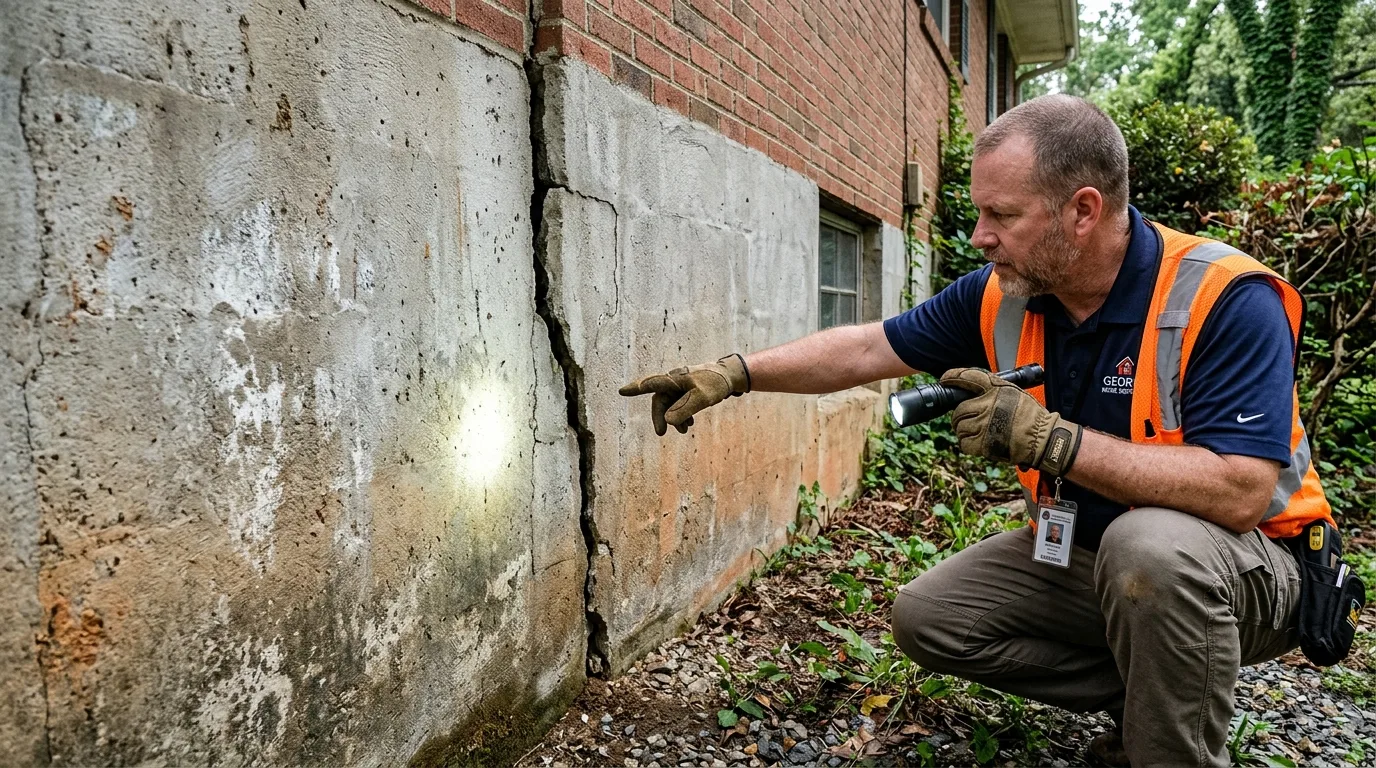
Most Acworth homeowners don’t think about foundation repair until they see a symptom that scares them — a crack in the drywall, a door that won’t close, a noticeable floor slope. By the time these symptoms appear, the underlying foundation movement has often been developing for years. Cobb County’s expansive red clay soil means that every Acworth home sits on a sub-base that shifts seasonally, and catching the early signs of foundation distress is significantly less expensive than addressing advanced structural movement.
In this post, we cover the five most reliable early warning signs of concrete foundation problems specific to Acworth’s clay-soil environment, when to call a professional, and what the repair process looks like.
Free Foundation Assessment in Acworth
Honest evaluation of your concrete foundation concerns — no pressure, no sales agenda. Call (888) 376-0955.
Why Foundation Problems Happen in Acworth More Than Other Markets
The answer is consistent: Cobb County’s Piedmont red clay soil. Unlike sandy or loam soils that drain freely and maintain relatively stable volume, Cobb County’s clay expands significantly when saturated — Acworth receives 52 inches of annual rainfall — and contracts dramatically during summer drought. The vertical and lateral movement this creates beneath foundation slabs is the primary driver of foundation distress throughout the area.
Homes in Centennial Lakes, built primarily in the 2010s, have newer foundations but are not immune — the clay beneath them is the same expansive material. Older properties in Historic Downtown Acworth and adjacent neighborhoods, where some homes date to the 1950s and 1960s, have had decades of clay cycling to create cumulative movement in their foundations. In both cases, the warning signs appear before catastrophic failure — if you know what to look for.
Sign 1: Diagonal Cracks at Door and Window Corners
Diagonal cracks running at 45-degree angles from the corners of door frames, window frames, and garage door openings are among the most diagnostic signs of foundation settling in Acworth homes. These cracks form because when a foundation section settles, the rigid frame above it tries to follow — the diagonal stress crack at the corner is where the wall framing accommodates the differential movement.
Horizontal cracks in walls and ceilings may be cosmetic (paint or drywall compound movement), but diagonal corner cracks are almost always structural signals. If you see diagonal cracks at multiple openings in the same area of your home — particularly if the cracks are on the same side of the house — a foundation assessment is warranted.
Sign 2: Doors and Windows That Stick or Won’t Close
Frame racking from foundation settling causes door frames and window frames to go out of square. The result: doors that rub at the top or bottom, that latch with difficulty, or that swing open or closed on their own. Windows that were easy to open last year are now difficult or require force.
This sign is particularly important when it develops suddenly or progressively. A door that has always been slightly stiff is different from a door that was fine six months ago and now requires force to close. Progressive sticking indicates ongoing settlement — the foundation is still moving.
Sign 3: Uneven or Bouncy Floors
Noticeable slope in interior flooring — where a marble placed on the floor rolls to one side of the room — indicates differential settlement in the foundation or floor system beneath. Bouncy or springy floors may indicate void formation beneath a concrete slab or a crawl space issue, where the sub-structure has lost support due to the same clay movement that affects slab foundations.
Use a long level to check floors in multiple rooms. A slope of more than 1 inch per 8 feet is generally considered a sign warranting professional evaluation. Consistent slope in one direction across multiple rooms indicates the foundation has settled on one side relative to the other.
Sign 4: Wide or Growing Cracks in the Concrete Slab
Cracks in a concrete floor or garage slab wider than 1/4 inch, or cracks that are visibly widening over time, indicate structural movement rather than simple concrete shrinkage. Concrete shrinkage cracks (normal in any slab) are typically hairline width and appear in the first few years after pouring. Wide cracks, particularly those with differential elevation on either side — where one slab section is higher than the adjacent one — indicate settlement rather than shrinkage.
Photograph and date any cracks you find in your concrete floors or garage slab. Recheck in 90 days. Growing cracks confirm ongoing movement; stable cracks may be historical and not currently active.
Concerned About Foundation Cracks in Your Acworth Home?
Free assessment — we diagnose root causes, not just symptoms. Serving all of Cobb County. Call (888) 376-0955.
Sign 5: Gaps at the Foundation-Wall Junction or Exterior Brick Separation
Visible gaps where the foundation meets the first-floor wall framing, or separation lines in exterior brick veneer — particularly at the corners where two walls meet — indicate that different parts of the structure have moved relative to each other. Brick separation in a horizontal stair-step pattern along mortar joints indicates foundation settling; vertical separation indicates rotation of a foundation section.
Gaps at the foundation-wall junction are serious signs that should prompt an immediate professional evaluation. They indicate that the foundation movement has progressed beyond early-stage settling to structural displacement.
Practical Uses: When Each Sign Requires Different Urgency
-
Single diagonal crack, no door or floor issues: Schedule an assessment within 1–3 months. Document the crack with photos and dimensions. Monitor for change.
-
Multiple diagonal cracks plus sticking doors: Schedule an assessment within 2–4 weeks. Multiple symptoms in the same area indicate active settling that may accelerate.
-
Sloping floors plus growing slab cracks: Schedule assessment immediately. This combination indicates significant structural movement that may be causing secondary damage to plumbing and mechanical systems.
-
Foundation-wall gaps or brick separation: Call the same day. These are late-stage signs of significant foundation displacement.
-
Cracks in exterior concrete surfaces (driveways, patios, steps) adjacent to the foundation: These may be early warning signs of foundation edge movement. Evaluate whether the concrete damage extends to the foundation itself.
How It Works: The Assessment and Repair Process
A foundation assessment for an Acworth home begins with a walk-through inspection: documenting all crack locations and patterns, checking door and window operation, measuring floor slopes with a level, and examining exterior drainage conditions around the foundation perimeter. Understanding how water flows around the home during rain is as important as examining the cracks themselves — drainage is often the root cause of the clay moisture cycling driving foundation movement.
Based on the assessment, repair options range from mudjacking (filling sub-base voids and lifting settled sections) and crack injection to partial slab replacement for sections with structural failure. Drainage correction — regrading, downspout extensions, or perimeter drainage systems — is often recommended alongside structural repair to eliminate the moisture cycling that caused the original movement. See our foundation repair page for Acworth homeowners for full details on repair approaches and costs.
Frequently Asked Questions
How urgent is foundation repair in Acworth if I only see one sign?
A single sign warrants documentation and professional evaluation within 1–3 months — not immediate emergency action, but not indefinite delay either. Foundation movement in Cobb County’s clay environment tends to be progressive: each wet-dry season cycle adds to cumulative movement. One sign today is rarely just one sign in two years.
Will foundation repair disrupt my daily life significantly?
Most foundation repairs in Acworth — including mudjacking and crack injection — are minimally invasive. The repair crew works on the slab itself, typically requiring 1–2 days. Full slab section replacement is more disruptive but is still generally completed within a week. Structural concrete repair does not typically require homeowners to vacate.
How much does foundation repair cost in Acworth?
Costs range from $500–$2,000 for mudjacking to fill voids under settled sections, to $300–$800 per crack for injection repair, to $8–$15 per square foot for full slab section replacement. Early-stage repairs cost substantially less than late-stage repairs — the homeowners in Kennesaw and Acworth who act at the first sign of foundation distress pay a fraction of what those who wait for advanced damage require. See our foundation repair service page for a full cost breakdown.
Don't Wait on Foundation Warning Signs in Acworth
Free assessments — serving Acworth, Kennesaw, Marietta, and all of Cobb County. Call (888) 376-0955.
Related: